

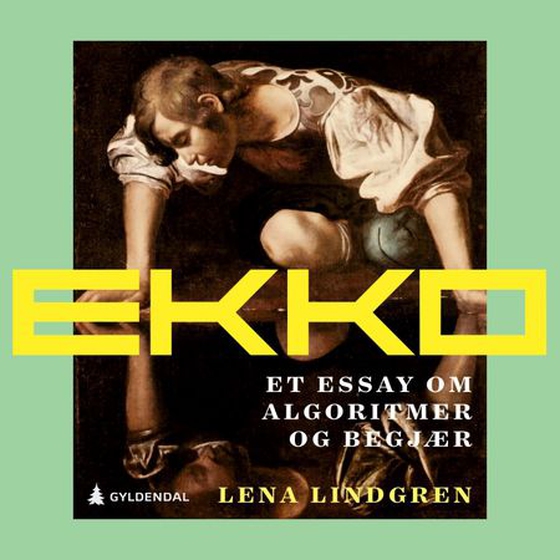
Ekko lydbok
Echo was the nymph who talked too much. For this, she was sentenced to a fate in which she could only repeat what others said.In the 2000s, we meet Echo in the principles of media technology: in viral memes, social-media shitstorms and echo chambers. Whoever has the algorithms on their side wins the attention economy’s highest prize: being visible. And Echo's great love was Narcissus, he who drow…




Echo was the nymph who talked too much. For this, she was sentenced to a fate in which she could only repeat what others said.
In the 2000s, we meet Echo in the principles of media technology: in viral memes, social-media shitstorms and echo chambers. Whoever has the algorithms on their side wins the attention economy’s highest prize: being visible. And Echo's great love was Narcissus, he who drowned in his own reflection.
In this essay, Lena Lindgren combines economics, mythology, psychology and science with scenes from Silicon Valley. It is a judgement of our age, a stream of consciousness, and an attempt to portray humanity's blind date with artificial intelligence.
Winner of the Brage Prize for Best Non-Fiction Book 2021
Foreign Sales:
Denmark, Straarup & Co
Germany, Kommode Verlag
Reviewers say:
6 out of 6 starts
“Highly recommended!”
Dagbladet
“... this is brilliantly considered, first-class essay-writing.”
Vårt Land
“Lena Lindgren has written a formidable essay about the enormous power of the tech giants. […] A gifted and humble attempt to understand the world we share. In fact, her essay is probably the most awareness-raising I have read in a Scandinavian language about the enormous power of the tech world.”
Morgenbladet
“Lena Lindgren’s essay on technology is awareness-raising and essential for society.”
Klassekampen
“Lena Lindgren’s debut is an exciting and thought-provoking essay on algorithms and Big Tech’s impact on humans, viewed through Ovid’s story of Echo and Narcissus.”
Bok365
“It never gets dull. In the end, I was left with the feeling of having been to something of an intellectual party.”
Aftenposten
“Images on the news were like historical paintings. The motley crew wandering around beneath the chandeliers – were they attempting a coup d’état? Instead of being armed with rifles, they carried smart phones, which most of the time they held up to film themselves.
The word “essay” comes from the French word “essai” meaning “attempt”, and with her book Echo Lena Lindgren certainly makes an impressive attempt at diagnosing contemporary society. Many people have described our current era as narcissistic. Lindgren refers to Ovid’s account of the myth of Narcissus, in which another figure is at least as important as the famous protagonist: the nymph Echo. Lindgren applies the mimetic theory developed by French philosopher and anthropologist René Girard in order to show that we might well be living in Echo’s era instead.
We make comparisons, imitate, “like” things that are “trending”, and as we click our way down a particular path, algorithms feed us more of the same. All of this creates potentially dangerous echo chambers, demonising the people we don’t agree with and polarising opinion – but it also results in fragile self-images and unhealthy body ideals. Who are these powerful tech giants that are constantly fighting for access to, and monitoring, whatever catches our attention on screen – just so they can feed us customised content and advertising? What do they think of us? What kind of world do they want?
Lena Lindgren attempts to find all the answers, like a true detective. And the process is as exciting as a thriller. Many people have written about the symptoms: polarised debates, shitstorms, cancel culture and radicalisation. Few, however, have gone straight to the source – to a technology that can accelerate our most primitive urges and instincts. It was high time that someone did this, and Lena Lindgren has done it brilliantly. Echo is an important and well written book. ”
Statement from the jury of the Brage Prize
