

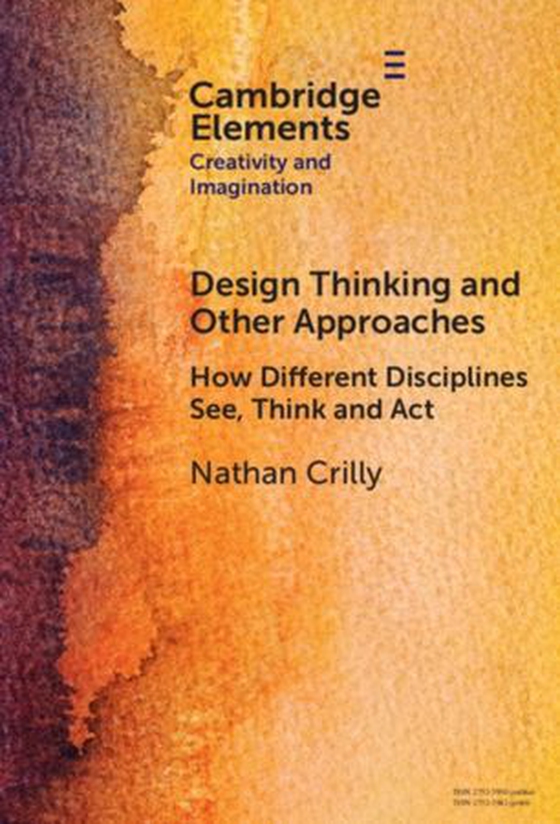
Nathan Crilly
(forfatter)
Design Thinking and Other Approaches (Elements in Creativity and Imagination) ebok
254,-
Efforts to promote creativity often centre on encouraging people to engage in ''design thinking'', ''systems thinking'' and ''entrepreneurial thinking''. These different approaches are most often defined, taught and applied in mutual isolation, which has obscured what distinguishes them from each other, what they have in common and how they might be combined. These three approaches are also most …
Efforts to promote creativity often centre on encouraging people to engage in ''design thinking'', ''systems thinking'' and ''entrepreneurial thinking''. These different approaches are most often defined, taught and applied in mutual isolation, which has obscured what distinguishes them from each other, what they have in common and how they might be combined. These three approaches are also most often described in isolation from the approaches that characterize other disciplines, all of which are relevant to how problems are identified, framed and solved. These other approaches include ''computational thinking'', ''engineering thinking'', ''scientific thinking'', ''evolutionary thinking'', ''mathematical thinking'', ''statistical thinking'', ''geographical thinking'', ''historical thinking'', ''anthropological thinking'' and many more. Examining these approaches as a set allows each of them to be better understood, and also reveals the connections and contrasts between them. Such comparisons provide the foundation for a more coordinated project to represent how different disciplinary approaches contribute to creative work.
Ebok
254,-



Undertittel
How Different Disciplines See, Think and Act
Forlag
Cambridge University Press
Utgitt
02.11.2026
Sjanger
Dokumentar og fakta, Politikk og samfunn
Språk
English
Format
epub
DRM-beskyttelse
LCP
ISBN
9781009498708
Efforts to promote creativity often centre on encouraging people to engage in ''design thinking'', ''systems thinking'' and ''entrepreneurial thinking''. These different approaches are most often defined, taught and applied in mutual isolation, which has obscured what distinguishes them from each other, what they have in common and how they might be combined. These three approaches are also most often described in isolation from the approaches that characterize other disciplines, all of which are relevant to how problems are identified, framed and solved. These other approaches include ''computational thinking'', ''engineering thinking'', ''scientific thinking'', ''evolutionary thinking'', ''mathematical thinking'', ''statistical thinking'', ''geographical thinking'', ''historical thinking'', ''anthropological thinking'' and many more. Examining these approaches as a set allows each of them to be better understood, and also reveals the connections and contrasts between them. Such comparisons provide the foundation for a more coordinated project to represent how different disciplinary approaches contribute to creative work.
Ingen vurderinger ennå
