

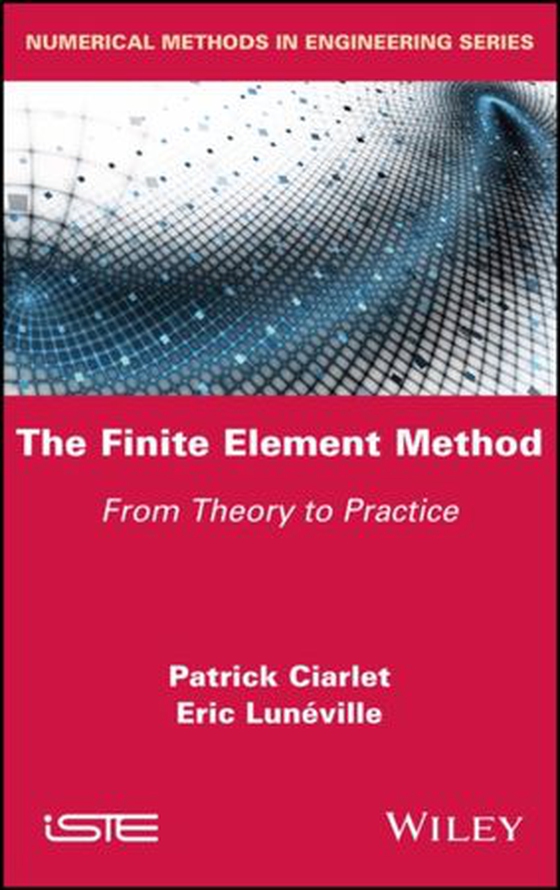
Patrick Ciarlet
(forfatter)
,
Eric Luneville
(forfatter)
Finite Element Method ebok
1773,-
The finite element method, which emerged in the 1950s to deal with structural mechanics problems, has since undergone continuous development. Using partial differential equation models, it is now present in such fields of application as mechanics, physics, chemistry, economics, finance and biology. It is also used in most scientific computing software, and many engineers become adept at using it …
The finite element method, which emerged in the 1950s to deal with structural mechanics problems, has since undergone continuous development. Using partial differential equation models, it is now present in such fields of application as mechanics, physics, chemistry, economics, finance and biology. It is also used in most scientific computing software, and many engineers become adept at using it in their modeling and numerical simulation activities.
This book presents all the essential elements of the finite element method in a progressive and didactic way: the theoretical foundations, practical considerations of implementation, algorithms, as well as numerical illustrations created in MATLAB. Original exercises with detailed answers are provided at the end of each chapter.
Ebok
1773,-





Undertittel
From Theory to Practice
Forlag
Wiley-ISTE
Utgitt
12.11.2026
Sjanger
Dokumentar og fakta
Språk
English
Format
epub
DRM-beskyttelse
LCP
ISBN
9781394229741
The finite element method, which emerged in the 1950s to deal with structural mechanics problems, has since undergone continuous development. Using partial differential equation models, it is now present in such fields of application as mechanics, physics, chemistry, economics, finance and biology. It is also used in most scientific computing software, and many engineers become adept at using it in their modeling and numerical simulation activities.
This book presents all the essential elements of the finite element method in a progressive and didactic way: the theoretical foundations, practical considerations of implementation, algorithms, as well as numerical illustrations created in MATLAB. Original exercises with detailed answers are provided at the end of each chapter.
Ingen vurderinger ennå
