

Linda Ruth Wheeldon
(forfatter)
,
Agnieszka Konopka
(forfatter)
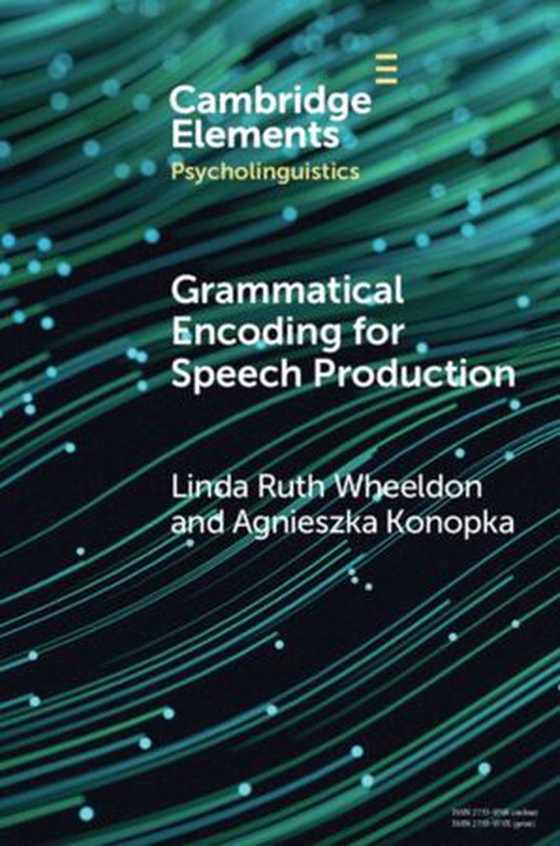
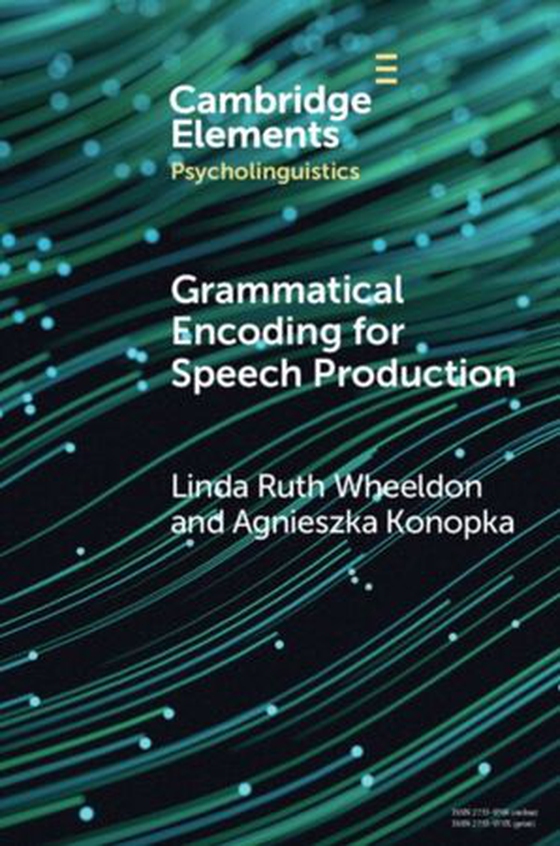
Grammatical Encoding for Speech Production (Elements in Psycholinguistics) ebok
254,-
During the production of spoken sentences, the linearisation of a ''thought'' is accomplished via the process of grammatical encoding, i.e., the building of a hierarchical syntactic frame that fixes the linear order of lexical concepts. While much research has demonstrated the independence of lexical and syntactic representations, exactly what is represented remains a matter of dispute. Moreover,…
During the production of spoken sentences, the linearisation of a ''thought'' is accomplished via the process of grammatical encoding, i.e., the building of a hierarchical syntactic frame that fixes the linear order of lexical concepts. While much research has demonstrated the independence of lexical and syntactic representations, exactly what is represented remains a matter of dispute. Moreover, theories differ in terms of whether words or syntax drive grammatical encoding. This debate is also central to theories of the time-course of grammatical encoding. Speaking is usually a rapid process in which articulation begins before an utterance has been entirely planned. Current theories of grammatical encoding make different claims about the scope of grammatical encoding prior to utterance onset, and the degree to which planning scope is determined by linguistic structure or by cognitive factors. The authors review current theories of grammatical encoding and evaluate them in light of relevant empirical evidence. This title is also available as Open Access on Cambridge Core.
Ebok
254,-





Forlag
Cambridge University Press
Utgitt
02.11.2026
Sjanger
Dokumentar og fakta
Språk
English
Format
epub
DRM-beskyttelse
LCP
ISBN
9781009264532
During the production of spoken sentences, the linearisation of a ''thought'' is accomplished via the process of grammatical encoding, i.e., the building of a hierarchical syntactic frame that fixes the linear order of lexical concepts. While much research has demonstrated the independence of lexical and syntactic representations, exactly what is represented remains a matter of dispute. Moreover, theories differ in terms of whether words or syntax drive grammatical encoding. This debate is also central to theories of the time-course of grammatical encoding. Speaking is usually a rapid process in which articulation begins before an utterance has been entirely planned. Current theories of grammatical encoding make different claims about the scope of grammatical encoding prior to utterance onset, and the degree to which planning scope is determined by linguistic structure or by cognitive factors. The authors review current theories of grammatical encoding and evaluate them in light of relevant empirical evidence. This title is also available as Open Access on Cambridge Core.
Ingen vurderinger ennå
