

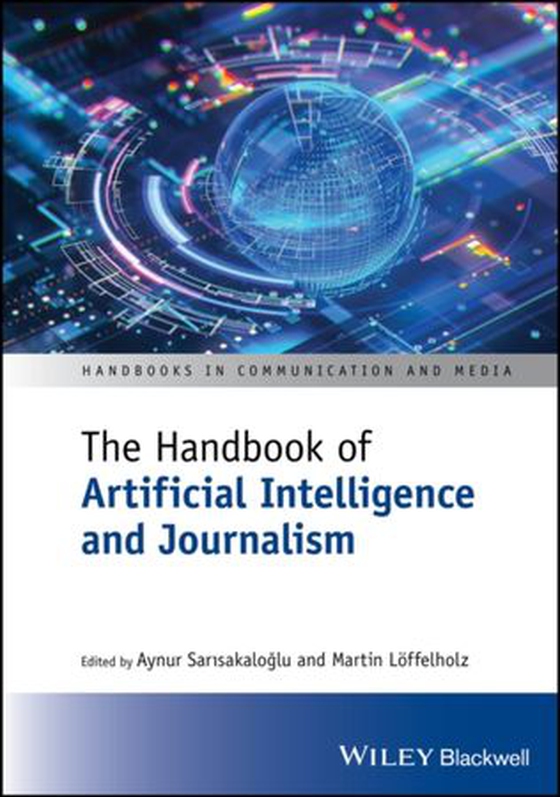
Aynur Sar sakalo lu
(redaktør)
,
Martin L ffelholz
(redaktør)
Handbook of Artificial Intelligence and Journalism ebok
2124,-
Presents a comprehensive global overview of AI-driven journalism and its transformative impact on media practices
As artificial intelligence (AI) continues to reshape the media landscape, The Handbook of Artificial Intelligence and Journalism provides the first comprehensive academic exploration of the intersection between AI technologies and journalism. Edited by Aynur Sarisakaloglu and Martin …
Presents a comprehensive global overview of AI-driven journalism and its transformative impact on media practices
As artificial intelligence (AI) continues to reshape the media landscape, The Handbook of Artificial Intelligence and Journalism provides the first comprehensive academic exploration of the intersection between AI technologies and journalism. Edited by Aynur Sarisakaloglu and Martin Löffelholz, this foundational volume brings together 37 leading scholars from six continents to examine how AI is redefining the structures, practices, and epistemologies of journalism.
Organized around key thematic areas, the Handbook investigates the driving forces propelling the algorithmic transformation and unveils emerging trends in journalistic practice and journalism research, moving beyond Western-centric perspectives to incorporate diverse global experiences and knowledge production. Twenty-eight original chapters address systemic shifts such as evolving structures of media organizations, changing roles of actors, transformations in news production routines, and shifting patterns of news consumption. By integrating theoretical, empirical, and practical perspectives, the Handbook sets the stage for a new research agenda for understanding AI-driven journalism on a global scale.
Containing rigorous interdisciplinary scholarship and broad geographical coverage, The Handbook of Artificial Intelligence and Journalism:
Integrates theoretical foundations, empirical studies, and practical applications in a cohesive structure
Offers insights into journalism practices across a wide range of geographical contexts and engages with approaches that transcends Western-dominated paradigms, incorporating perspectives from the Global South
Employs interdisciplinary frameworks to enhance the understanding of AI-driven journalism
Examines the sociotechnical dynamics of AI, including its potential benefits and challenges for journalism
Presents forward-looking reflections on the future of journalism research in the AI era
The Handbook of Artificial Intelligence and Journalism is ideal for undergraduate, graduate, and doctoral students in journalism, communication, and media studies programs. It also serves as a vital reference for researchers, educators, media professionals, and policy advisors engaged in digital journalism, journalism research, media innovation, and public communication.
Ebok
2124,-





Forlag
Wiley
Utgitt
30.07.2026
Sjanger
Dokumentar og fakta
Språk
English
Format
epub
DRM-beskyttelse
LCP
ISBN
9781394250400
Presents a comprehensive global overview of AI-driven journalism and its transformative impact on media practices
As artificial intelligence (AI) continues to reshape the media landscape, The Handbook of Artificial Intelligence and Journalism provides the first comprehensive academic exploration of the intersection between AI technologies and journalism. Edited by Aynur Sarisakaloglu and Martin Löffelholz, this foundational volume brings together 37 leading scholars from six continents to examine how AI is redefining the structures, practices, and epistemologies of journalism.
Organized around key thematic areas, the Handbook investigates the driving forces propelling the algorithmic transformation and unveils emerging trends in journalistic practice and journalism research, moving beyond Western-centric perspectives to incorporate diverse global experiences and knowledge production. Twenty-eight original chapters address systemic shifts such as evolving structures of media organizations, changing roles of actors, transformations in news production routines, and shifting patterns of news consumption. By integrating theoretical, empirical, and practical perspectives, the Handbook sets the stage for a new research agenda for understanding AI-driven journalism on a global scale.
Containing rigorous interdisciplinary scholarship and broad geographical coverage, The Handbook of Artificial Intelligence and Journalism:
Integrates theoretical foundations, empirical studies, and practical applications in a cohesive structure
Offers insights into journalism practices across a wide range of geographical contexts and engages with approaches that transcends Western-dominated paradigms, incorporating perspectives from the Global South
Employs interdisciplinary frameworks to enhance the understanding of AI-driven journalism
Examines the sociotechnical dynamics of AI, including its potential benefits and challenges for journalism
Presents forward-looking reflections on the future of journalism research in the AI era
The Handbook of Artificial Intelligence and Journalism is ideal for undergraduate, graduate, and doctoral students in journalism, communication, and media studies programs. It also serves as a vital reference for researchers, educators, media professionals, and policy advisors engaged in digital journalism, journalism research, media innovation, and public communication.
Ingen vurderinger ennå
