

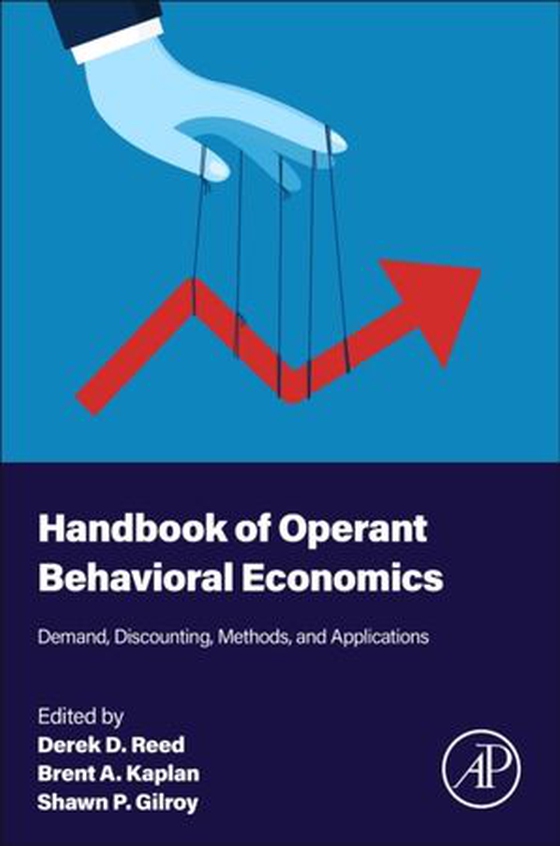
Handbook of Operant Behavioral Economics ebok
1716,-
Handbook of Operant Behavioral Economics: Demand, Discounting, Methods, and Applications delves into the rapidly evolving field of behavioral economics, focusing specifically on the operant approach that marries operant learning principles with microeconomic theory. This comprehensive guide begins with a brief history of behavioral economics, setting the stage for a more thorough review of operan…
Handbook of Operant Behavioral Economics: Demand, Discounting, Methods, and Applications delves into the rapidly evolving field of behavioral economics, focusing specifically on the operant approach that marries operant learning principles with microeconomic theory. This comprehensive guide begins with a brief history of behavioral economics, setting the stage for a more thorough review of operant demand and reward discounting. It presents both human and nonhuman research methods, offering critical insights into how these methodologies can be employed to study consumption behaviors and decision-making processes. This book also features quantitative models that elucidate operant demand and discounting, along with practical applications that extend the relevance of these concepts to real-world scenarios. Additionally, it highlights the policy implications of applied behavioral economics, bridging the gap between theory and practice. With a strong emphasis on consumer behavior analysis as a foundational element, this handbook equips readers with the knowledge to translate academic research into actionable policy. Designed for graduate students, clinicians, and academics alike, this resource is ideal for those looking to deepen their understanding of behavioral economics and its applications.- Integrates operant learning principles with economic theories to create a robust framework for understanding consumer behavior.- Identifies key policy implications derived from operant behavioral economics to inform evidence-based decision-making in various sectors.- Develops strategies for utilizing behavioral economics in educational settings, enhancing teaching methodologies and student engagement.- Assesses the role of reward discounting in shaping consumer choices and its impact on long-term decision-making processes.- Facilitates interdisciplinary collaboration by highlighting connections between behavioral economics and fields such as psychology, economics, and public health.
Ebok
1716,-




Undertittel
Demand, Discounting, Methods, and Applications
Forlag
Academic Press
Utgitt
30.07.2026
Sjanger
Dokumentar og fakta, Politikk og samfunn
Språk
English
Format
epub
DRM-beskyttelse
LCP
ISBN
9780323957465
Handbook of Operant Behavioral Economics: Demand, Discounting, Methods, and Applications delves into the rapidly evolving field of behavioral economics, focusing specifically on the operant approach that marries operant learning principles with microeconomic theory. This comprehensive guide begins with a brief history of behavioral economics, setting the stage for a more thorough review of operant demand and reward discounting. It presents both human and nonhuman research methods, offering critical insights into how these methodologies can be employed to study consumption behaviors and decision-making processes. This book also features quantitative models that elucidate operant demand and discounting, along with practical applications that extend the relevance of these concepts to real-world scenarios. Additionally, it highlights the policy implications of applied behavioral economics, bridging the gap between theory and practice. With a strong emphasis on consumer behavior analysis as a foundational element, this handbook equips readers with the knowledge to translate academic research into actionable policy. Designed for graduate students, clinicians, and academics alike, this resource is ideal for those looking to deepen their understanding of behavioral economics and its applications.- Integrates operant learning principles with economic theories to create a robust framework for understanding consumer behavior.- Identifies key policy implications derived from operant behavioral economics to inform evidence-based decision-making in various sectors.- Develops strategies for utilizing behavioral economics in educational settings, enhancing teaching methodologies and student engagement.- Assesses the role of reward discounting in shaping consumer choices and its impact on long-term decision-making processes.- Facilitates interdisciplinary collaboration by highlighting connections between behavioral economics and fields such as psychology, economics, and public health.
Ingen vurderinger ennå
