

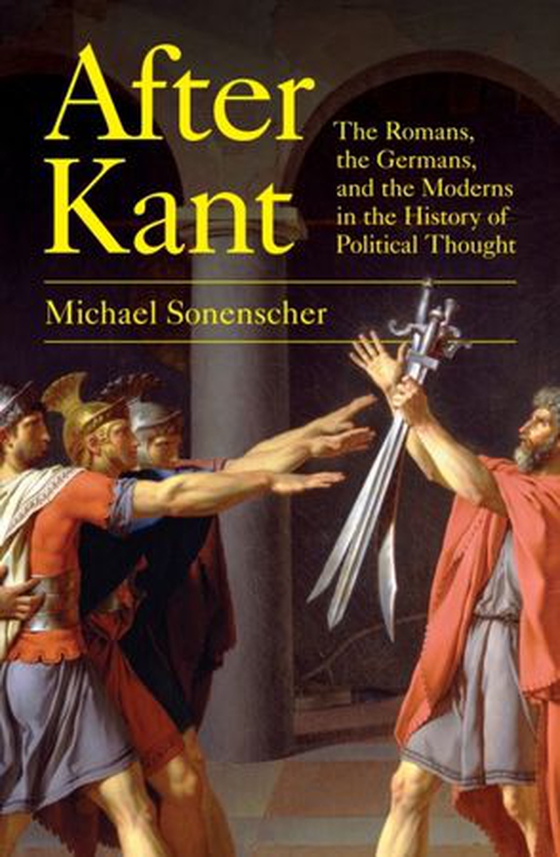
Michael Sonenscher
(forfatter)
After Kant ebok
676,-
Tracing the origins of modern political thought through three sets of arguments over history, morality, and freedom
In this wide-ranging work, Michael Sonenscher traces the origins of modern political thought and ideologies to a question, raised by Immanuel Kant, about what is involved in comparing individual human lives to the whole of human history. How can we compare them, or understand the r…
Tracing the origins of modern political thought through three sets of arguments over history, morality, and freedom
In this wide-ranging work, Michael Sonenscher traces the origins of modern political thought and ideologies to a question, raised by Immanuel Kant, about what is involved in comparing individual human lives to the whole of human history. How can we compare them, or understand the results of the comparison? Kant’s question injected a new, future-oriented dimension into existing discussions of prevailing norms, challenging their orientation toward the past. This reversal made Kant’s question a bridge between three successive sets of arguments: between the supporters of the ancients and moderns, the classics and romantics, and the Romans and the Germans. Sonenscher argues that the genealogy of modern political ideologies—from liberalism to nationalism to communism—can be connected to the resulting discussions of time, history, and values, mainly in France but also in Germany, Switzerland, and Britain, in the period straddling the French and Industrial revolutions.
What is the genuinely human content of human history? Everything begins somewhere—democracy with the Greeks, or the idea of a res publica with the Romans—but these local arrangements have become vectors of values that are, apparently, universal. The intellectual upheaval that Sonenscher describes involved a struggle to close the gap, highlighted by Kant, between individual lives and human history. After Kant is an examination of that struggle’s enduring impact on the history and the historiography of political thought.
Ebok
676,-




Undertittel
The Romans, the Germans, and the Moderns in the History of Political Thought
Forlag
Princeton University Press
Utgitt
18.11.2026
Sjanger
Religion og livssyn, Historie, Dokumentar og fakta, Politikk og samfunn
Språk
English
Format
epub
DRM-beskyttelse
LCP
ISBN
9780691245645
Tracing the origins of modern political thought through three sets of arguments over history, morality, and freedom
In this wide-ranging work, Michael Sonenscher traces the origins of modern political thought and ideologies to a question, raised by Immanuel Kant, about what is involved in comparing individual human lives to the whole of human history. How can we compare them, or understand the results of the comparison? Kant’s question injected a new, future-oriented dimension into existing discussions of prevailing norms, challenging their orientation toward the past. This reversal made Kant’s question a bridge between three successive sets of arguments: between the supporters of the ancients and moderns, the classics and romantics, and the Romans and the Germans. Sonenscher argues that the genealogy of modern political ideologies—from liberalism to nationalism to communism—can be connected to the resulting discussions of time, history, and values, mainly in France but also in Germany, Switzerland, and Britain, in the period straddling the French and Industrial revolutions.
What is the genuinely human content of human history? Everything begins somewhere—democracy with the Greeks, or the idea of a res publica with the Romans—but these local arrangements have become vectors of values that are, apparently, universal. The intellectual upheaval that Sonenscher describes involved a struggle to close the gap, highlighted by Kant, between individual lives and human history. After Kant is an examination of that struggle’s enduring impact on the history and the historiography of political thought.
Ingen vurderinger ennå
