Kellie Carter Jackson
(forfatter)
We Refuse ebok
149,-
An “unsparing, erudite, and incisive” (Jelani Cobb, staff writer, The New Yorker) reframing of the past and present of Black resistance—both nonviolent and violent—to white supremacyNamed a Best Book of 2024 by Smithsonian * Kirkus * Chicago Review of Books * Emancipator Black resistance to white supremacy is often reduced to a simple binary, between Dr. Martin Luther King Jr.’s nonviolence and M…
An “unsparing, erudite, and incisive” (Jelani Cobb, staff writer, The New Yorker) reframing of the past and present of Black resistance—both nonviolent and violent—to white supremacyNamed a Best Book of 2024 by Smithsonian * Kirkus * Chicago Review of Books * Emancipator Black resistance to white supremacy is often reduced to a simple binary, between Dr. Martin Luther King Jr.’s nonviolence and Malcolm X’s “by any means necessary.” In We Refuse, historian Kellie Carter Jackson looks beyond this false choice, offering an unflinching examination of the breadth of Black responses to white oppression, particularly those pioneered by Black women. The dismissal of “Black violence” as an illegitimate form of resistance is itself a manifestation of white supremacy. Force—from work stoppages and property destruction to armed revolt—has played a pivotal part in securing freedom and justice for Black people for centuries. But force is only one tool among many. Carter Jackson examines other, no less vital tactics that have shaped the Black struggle, from the restorative power of finding joy in the face of suffering to the quiet strength of simply walking away.
Undertittel
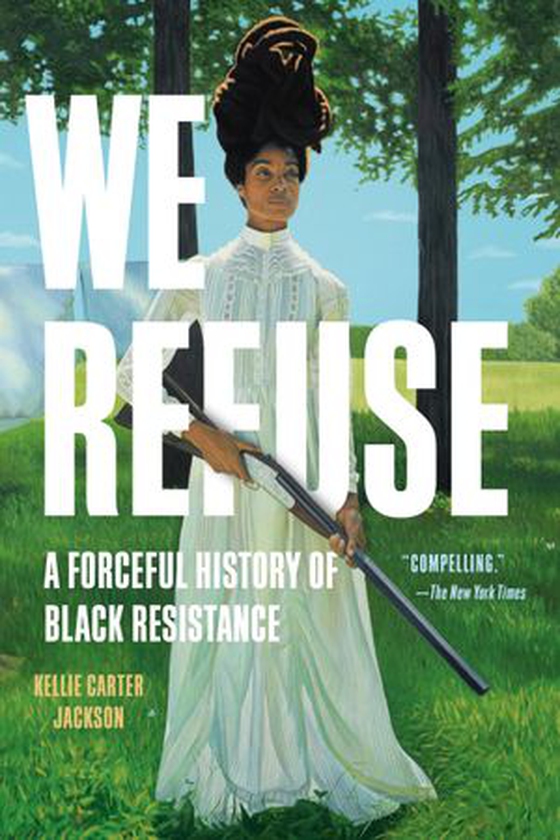
A Forceful History of Black Resistance
Forlag
Seal Press
Utgitt
04.06.2024
Sjanger
Historie, Dokumentar og fakta, Politikk og samfunn
Språk
English
Format
epub
DRM-beskyttelse
LCP
ISBN
9781541602915
An “unsparing, erudite, and incisive” (Jelani Cobb, staff writer, The New Yorker) reframing of the past and present of Black resistance—both nonviolent and violent—to white supremacy
Named a Best Book of 2024 by Smithsonian * Kirkus * Chicago Review of Books * Emancipator
Black resistance to white supremacy is often reduced to a simple binary, between Dr. Martin Luther King Jr.’s nonviolence and Malcolm X’s “by any means necessary.” In We Refuse, historian Kellie Carter Jackson looks beyond this false choice, offering an unflinching examination of the breadth of Black responses to white oppression, particularly those pioneered by Black women.
The dismissal of “Black violence” as an illegitimate form of resistance is itself a manifestation of white supremacy. Force—from work stoppages and property destruction to armed revolt—has played a pivotal part in securing freedom and justice for Black people for centuries. But force is only one tool among many. Carter Jackson examines other, no less vital tactics that have shaped the Black struggle, from the restorative power of finding joy in the face of suffering to the quiet strength of simply walking away.
Named a Best Book of 2024 by Smithsonian * Kirkus * Chicago Review of Books * Emancipator
Black resistance to white supremacy is often reduced to a simple binary, between Dr. Martin Luther King Jr.’s nonviolence and Malcolm X’s “by any means necessary.” In We Refuse, historian Kellie Carter Jackson looks beyond this false choice, offering an unflinching examination of the breadth of Black responses to white oppression, particularly those pioneered by Black women.
The dismissal of “Black violence” as an illegitimate form of resistance is itself a manifestation of white supremacy. Force—from work stoppages and property destruction to armed revolt—has played a pivotal part in securing freedom and justice for Black people for centuries. But force is only one tool among many. Carter Jackson examines other, no less vital tactics that have shaped the Black struggle, from the restorative power of finding joy in the face of suffering to the quiet strength of simply walking away.
Ingen vurderinger ennå