

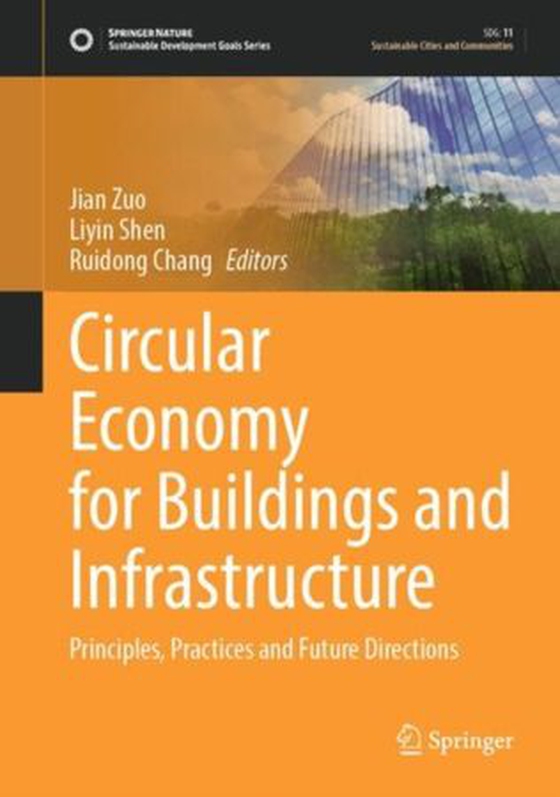
Circular Economy for Buildings and Infrastructure ebok
2110,-
This edited volume covers theoretical and practical aspects of circular economy in building development, offering chapters dealing with topics such as material design, affordability of housing development, waste management and recycling, smart metering, and more. A particular focus is placed on various stakeholders’ points of view. The book''s chapters are co-developed and contributed by multidis…
This edited volume covers theoretical and practical aspects of circular economy in building development, offering chapters dealing with topics such as material design, affordability of housing development, waste management and recycling, smart metering, and more. A particular focus is placed on various stakeholders’ points of view. The book''s chapters are co-developed and contributed by multidisciplinary teams including both academics and industry practitioners. The case study-oriented approach taken here helps to facilitate the reader''s understanding of how building sustainability can be achieved in the context of circular economy.
The building industry has significant environmental, social and economic impacts. As one of the biggest energy consumers and carbon emitters, building sustainability has attracted wide attention globally. Building projects and their associated activities consume a large amount of energy, natural resources and water while producing a large proportion of wastes throughout their lifecycles. The traditional linear approach of “make, use and dispose” has been heavily criticized, whilst the circular approach has gained momentum. Indeed, circular economy has emerged as one of key principles to manage sustainability related issues by means of focusing on the circularity of resources as well as the cost implications.
Ebok
2110,-




Undertittel
Principles, Practices and Future Directions
Forlag
Springer
Utgitt
10.06.2026
Sjanger
Kunst og kultur, Dokumentar og fakta, Politikk og samfunn
Språk
English
Format
epub
DRM-beskyttelse
LCP
ISBN
9783031562419
This edited volume covers theoretical and practical aspects of circular economy in building development, offering chapters dealing with topics such as material design, affordability of housing development, waste management and recycling, smart metering, and more. A particular focus is placed on various stakeholders’ points of view. The book''s chapters are co-developed and contributed by multidisciplinary teams including both academics and industry practitioners. The case study-oriented approach taken here helps to facilitate the reader''s understanding of how building sustainability can be achieved in the context of circular economy.
The building industry has significant environmental, social and economic impacts. As one of the biggest energy consumers and carbon emitters, building sustainability has attracted wide attention globally. Building projects and their associated activities consume a large amount of energy, natural resources and water while producing a large proportion of wastes throughout their lifecycles. The traditional linear approach of “make, use and dispose” has been heavily criticized, whilst the circular approach has gained momentum. Indeed, circular economy has emerged as one of key principles to manage sustainability related issues by means of focusing on the circularity of resources as well as the cost implications.
Ingen vurderinger ennå
