

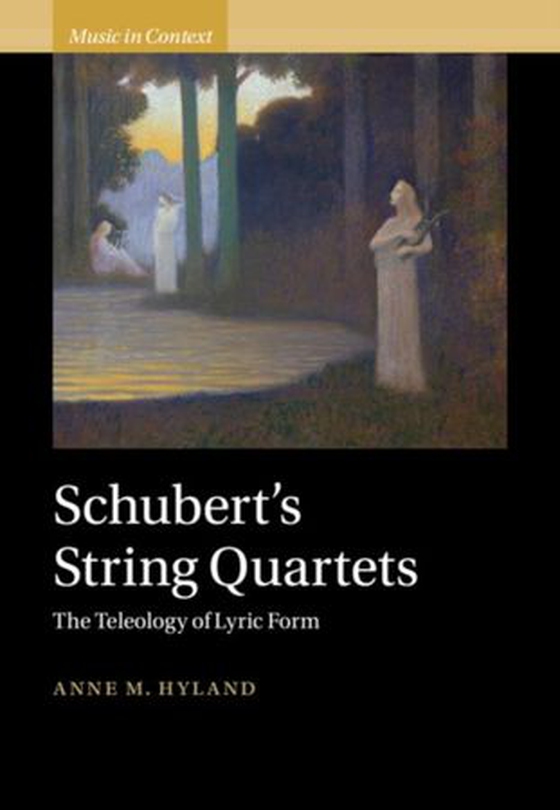
Anne Hyland
(forfatter)
Schubert's String Quartets (Music in Context) ebok
1238,-
Franz Schubert''s music has long been celebrated for its lyrical melodies, ''heavenly length'' and daring harmonic language. In this new study of Schubert''s complete string quartets, Anne Hyland challenges the influential but under-explored claim that Schubert could not successfully incorporate the lyric style into his sonatas, and offers a novel perspective on lyric form that embraces historica…
Franz Schubert''s music has long been celebrated for its lyrical melodies, ''heavenly length'' and daring harmonic language. In this new study of Schubert''s complete string quartets, Anne Hyland challenges the influential but under-explored claim that Schubert could not successfully incorporate the lyric style into his sonatas, and offers a novel perspective on lyric form that embraces historical musicology, philosophy and music theory and analysis. Her exploration of the quartets reveals Schubert''s development of a lyrically conceived teleology, bringing musical form, expression and temporality together in the service of fresh intellectual engagement. Her formal analyses grant special focus to the quartets of 1810–16, isolating the questions they pose for existing music theory and employing these as a means of scrutinising the relationship between the concepts of lyricism, development, closure and teleology thereby opening up space for these works to challenge some of the discourses that have historically beset them.
Ebok
1238,-



Undertittel
The Teleology of Lyric Form
Forlag
Cambridge University Press
Utgitt
02.11.2026
Sjanger
Kunst og kultur, Dokumentar og fakta
Serie
Music in Context
Språk
English
Format
epub
DRM-beskyttelse
LCP
ISBN
9781009210874
Franz Schubert''s music has long been celebrated for its lyrical melodies, ''heavenly length'' and daring harmonic language. In this new study of Schubert''s complete string quartets, Anne Hyland challenges the influential but under-explored claim that Schubert could not successfully incorporate the lyric style into his sonatas, and offers a novel perspective on lyric form that embraces historical musicology, philosophy and music theory and analysis. Her exploration of the quartets reveals Schubert''s development of a lyrically conceived teleology, bringing musical form, expression and temporality together in the service of fresh intellectual engagement. Her formal analyses grant special focus to the quartets of 1810–16, isolating the questions they pose for existing music theory and employing these as a means of scrutinising the relationship between the concepts of lyricism, development, closure and teleology thereby opening up space for these works to challenge some of the discourses that have historically beset them.
Ingen vurderinger ennå
