

George Weigel
(forfatter)
The Cube and the Cathedral ebok
89,-
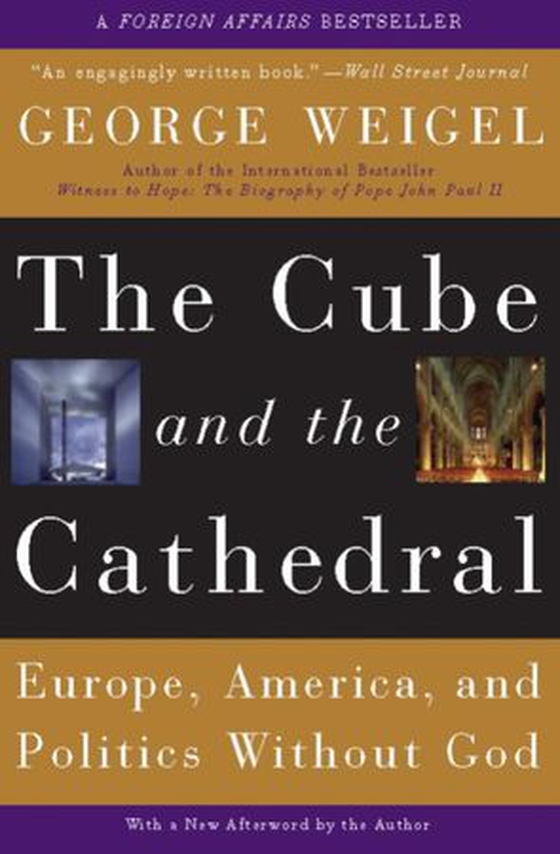
Why do Europeans and Americans see the world so differently? Why do Europeans and Americans have such different understandings of democracy and its discontents in the twenty-first century? Contrasting the civilization that produced the starkly modernist "cube" of the Great Arch of La Defense in Paris with the civilization that produced the "cathedral" of Notre-Dame, George Weigel argues that Euro…
Why do Europeans and Americans see the world so differently? Why do Europeans and Americans have such different understandings of democracy and its discontents in the twenty-first century? Contrasting the civilization that produced the starkly modernist "cube" of the Great Arch of La Defense in Paris with the civilization that produced the "cathedral" of Notre-Dame, George Weigel argues that Europe's embrace of a narrow secularism has led to a crisis of morale that is eroding Europe's soul and threatening its future -- with dire lessons for the rest of the democratic world. Weigel traces the origins of "Europe's problem" to the atheistic humanism of the nineteenth-century European intellectual life, which set in motion a historical process that produced two world wars, three totalitarian systems, the Gulag, Auschwitz, the Cold War -- and, most ominously, the Continent's de-population, which is worse today than during the Black Death. And yet, many Europeans still insist -- most recently, during the debate over a new EU constitution -- that only a public square shorn of religiously-informed moral argument is safe for human rights and democracy. Precisely the opposite, Weigel suggests, is true: the people of the "cathedral" can give a compelling account of their commitment to everyone's freedom; the people of the "cube" cannot. Can there be any true "politics" -- any true deliberation about the common good, and any robust defense of freedom -- without God? George Weigel makes a powerful case that the answer is "No," because, in the final analysis, societies are only as great as their spiritual aspirations.




Undertittel
Europe, America, and Politics Without God
Forlag
Basic Books
Utgitt
01.01.2008
Sjanger
Språk
English
Format
epub
DRM-beskyttelse
LCP
ISBN
9780786722259
Why do Europeans and Americans see the world so differently? Why do Europeans and Americans have such different understandings of democracy and its discontents in the twenty-first century? Contrasting the civilization that produced the starkly modernist "cube" of the Great Arch of La Defense in Paris with the civilization that produced the "cathedral" of Notre-Dame, George Weigel argues that Europe's embrace of a narrow secularism has led to a crisis of morale that is eroding Europe's soul and threatening its future -- with dire lessons for the rest of the democratic world. Weigel traces the origins of "Europe's problem" to the atheistic humanism of the nineteenth-century European intellectual life, which set in motion a historical process that produced two world wars, three totalitarian systems, the Gulag, Auschwitz, the Cold War -- and, most ominously, the Continent's de-population, which is worse today than during the Black Death. And yet, many Europeans still insist -- most recently, during the debate over a new EU constitution -- that only a public square shorn of religiously-informed moral argument is safe for human rights and democracy. Precisely the opposite, Weigel suggests, is true: the people of the "cathedral" can give a compelling account of their commitment to everyone's freedom; the people of the "cube" cannot. Can there be any true "politics" -- any true deliberation about the common good, and any robust defense of freedom -- without God? George Weigel makes a powerful case that the answer is "No," because, in the final analysis, societies are only as great as their spiritual aspirations.
Ingen vurderinger ennå
